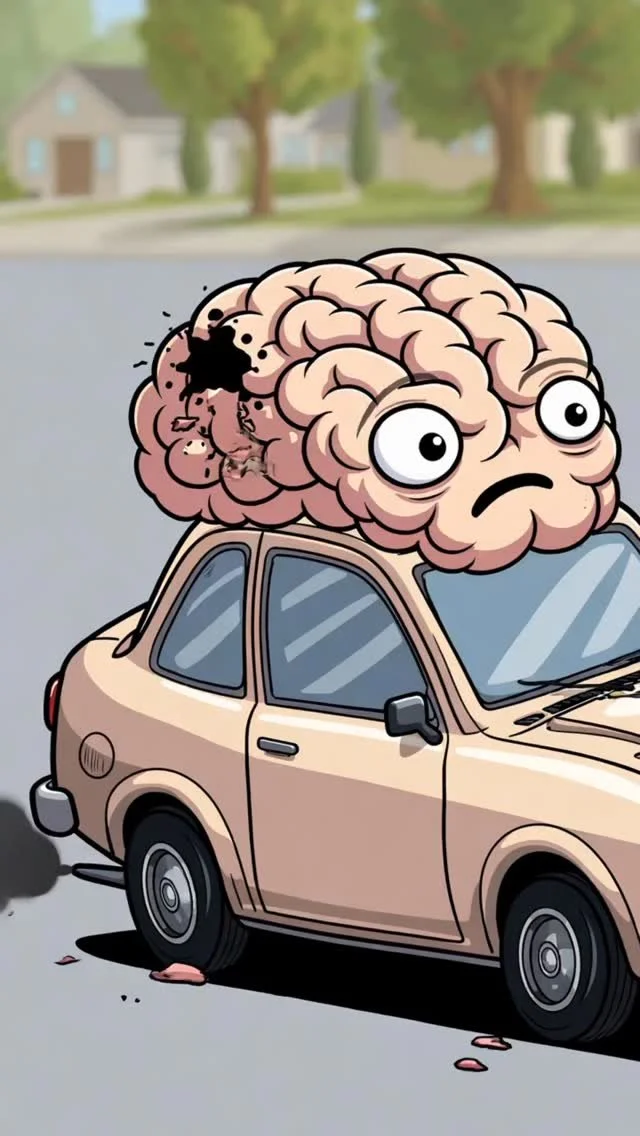
Pounding Headache, Fading Words
I sat down today with the best of intentions. Laptop open, a glass of lemonade, notes scattered across the table like I actually had a plan. The goal? Write a blog post about life with traumatic brain injury (TBI) recovery. Something honest, maybe a little hopeful, definitely real.
Instead, I got... this:
About fifteen minutes in, the familiar pressure started building behind my eyes. Not the dramatic Hollywood migraine with flashing lights and vomiting—just a slow, stubborn fog that turns simple thoughts into tangled knots. I’d type a sentence, then stare at it wondering if it even made sense. Delete. Rewrite. Delete again. The words that felt clear in my head came out jumbled on the screen, like someone had rearranged the letters while I wasn’t looking.
This is TBI recovery in a nutshell for me right now: the intention is there, the effort is there, but the brain hardware is still rebooting. And when a headache joins the party, even basic thoughts get confusing.
What a “Normal” Writing Session Can Look Like These Days
I’ll start with an idea: “Share how cognitive fatigue shows up during creative tasks in my recovery.”
Sounds straightforward, right? My brain agrees... for about thirty seconds. Then the headache creeps in, and suddenly:
I can’t remember the exact word I wanted. “Cognitive fatigue” becomes “that tired brain thing.”
Sentences that should flow feel like I’m pushing them uphill through mud.
I read the same paragraph four times and still can’t tell if it’s coherent.
Focus slips away like sand through fingers. One moment I’m writing; the next I’m staring at the wall, wondering what I was doing.
It’s not laziness. It’s not lack of discipline. It’s neurology doing its messy, slow repair work.
Headaches during TBI recovery are incredibly common. They can be triggered by screen time, concentration, stress, light, noise, biological imbalances or physical injury, or sometimes nothing at all. For me, trying to organize thoughts and put them into written form is like asking a bruised muscle to run a marathon. The muscle wants to cooperate. It just... can’t. Not yet.
The Frustration Loop
Here’s the really annoying part: the more I push through the headache to “just finish this one post,” the worse the symptoms get. It becomes a vicious cycle:
Try to write → Headache intensifies → Thoughts get more scrambled.
Get frustrated with myself → Stress rises → Headache gets louder.
Feel guilty for not being more productive → More stress → Rinse and repeat.
I’ve had days where I spend hours on something that should take thirty minutes, only to scrap most of it because it reads like it was written by, well, a toddler if they could write.
And then comes the emotional layer: Grief - for the version of my brain that could crank out clear, flowing prose without thinking twice. Anger - that something as “simple” as writing a blog feels monumental. Worry - that I’ll never get back to where I was.
But here’s what I’m learning (slowly, painfully, one foggy day at a time):
Small Wins Matter More Than Perfect Posts
Today, I didn’t write the deep, insightful, well-structured blog I planned. What I did manage was this raw, messy, honest one. And that counts. I’ve found that writing while respecting my brain’s limitations allows me to slowly improve my abilities over time. Today:
I showed up.
I put words on the page even when they fought me.
I’m practicing self-compassion instead of self-criticism (still a work in progress).
That is progress. If you’re recovering from TBI or any brain-related challenge and you’re trying to create, work, study, or just function—please know this: your effort is visible even when the results feel invisible. The brain is healing in ways we can’t always measure on a given day. I’m not perfect, I’m still healing, but I have been able to write a few posts - which is more progress than the couple of years before!
Some practical things that sometimes help me when the headache fog rolls in:
Short sprints: 10–15 minutes of writing, then a break (even if it feels like I’m “wasting time”). Listening to my brain.
Voice-to-text when typing hurts too much to save the idea or phrasing that I have before I forget it.
Dim lights or switching to paper and pen for a while to reduce the load for my eyes.
Accepting that “good enough” is sometimes the victory.
Rest instead of forcing it when symptoms spike.
I don’t have neat conclusions or five-step recovery hacks today. My head is still throbbing, and the thoughts are still slippery. But I hit “publish” anyway.
Because showing up messy is better than not showing up at all. Some progress is better than no progress. Recovery isn’t linear. I started with an idea of what I wanted to write about. I didn’t write about that idea at all. Instead this is what I have to offer today. It may not be what I hoped for, but it is more than I could offer a year ago, two years ago, or right after my injury. It is progress. I’m grateful for that. Writing my blog isn’t about having the perfect words. It is about sharing my genuine story. Today, that story is right here - healing, learning, growing - with a pounding headache causing my words to fade.
If you’re in a similar boat—whether it’s TBI, chronic illness, mental health struggles, or just a season where your brain feels like it’s betraying you—I see you. You’re not alone in the fog.
We’ll keep writing our imperfect posts, living our imperfect days, and healing at our own imperfect pace.
And maybe, just maybe, the headaches will loosen their grip a little more tomorrow.
Until then, be kind to your brain. It’s doing its best.
With foggy but genuine gratitude,
A Fellow Recovering Brain
P.S. If this post feels a little disjointed or repetitive in places... well, now you know why. Real recovery isn’t always polished. Sometimes it’s exactly this.