
Why am I a Zombie?
I don’t remember much of the first couple of years from my injury. But I’m forever grateful that prior to my injury I had learned the skill of journaling from a leadership course I had attended for my job. This skillset would prove to be one among many TBI recovery skills that are often taught post-injury to Brain Injured patients that I had been blessed to by chance develop ahead of time. These skills somehow miraculously assisted in being able to regain entry into my job after the initial months of recovery off even though barely functioning internally. I don’t have as many journal entries as I retrospectively wish I would have had from the first year, but from what I can gather as I reread these early ones, the bulk of my initial days were literally sleeping. 18+ hours on most days. Falling asleep in the middle of loud activity all around. My time awake was spent staring out the window, at nothing truly. Unable to focus. Every light too much. Each sound so painful. These spots in my vision distracting, draining, confusing. Unable to do much and with little company there often was not much to journal about beyond my kids and wife in the pieces I could gather and understand, but I also thought I “just” had a concussion and was just resting and getting better and then eventually “just” Post Concussive Syndrome and just need to keep resting and I’ll be better. I never knew what this was and would end up being.
Early on I could not watch anything. The TV made me sick physically. Each scene cut transition every 3 seconds was too quick to process, too overstimulating for me. In the first days, I recorded that my wife and I went to watch a movie and I had it turned off within five minutes unable to process even the sound with my eyes shut. Everything was too much. It hurt, made me nauseous, and was overwhelming in a way that is so difficult to describe.
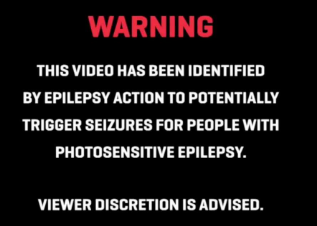
Thankfully, this did get better in time. Eventually I could hear the show but not watch it still. Then, finally after months, I could watch it too. Yet even now, three years later, I still have times watching a show is too much. These photosensitivity warnings are something I used to try to skip past to get movies and shows started. Now, they can save my entire day from overstimulation. It is funny how I always noticed these warnings before my injury, but never understood how truly difficult something so routine and regular like watching a television show or movie could be with sensitivity to light, sounds and rapid changes to process.
Today, I watched a reel by Hope Survives about how 1 in 4 people surveyed have a history of a traumatic brain injury in some fashion and seeing Cristabelle Braden remind us how so many TBI survivors walk around looking like regular people with a hidden disability and struggles beneath the surface. She shares that looking at her you can not tell she had a brain injury, like so many other survivors, myself included most times. I reread one of my journal entries I wrote in the first month of my recovery process that broke my heart today related to that truth, as while now you can look at me and not know, there was a time early on you could tell something was wrong with me.
The journal entry described when two of my amazing younger sisters that lived down the road, came over in June of 2023 for the first time in weeks after my injury. Having not had visitors for a couple of weeks, they entered our home but yet instantly it was like nothing I had ever seen on their face before. They sat awkwardly on the floor of our house below the windows in the living room. This was awkward enough, but my journal that day tried to really capture the most awkward and unique part which was a look from each of them I had not seen before. My journal says that I had thought I would see their beautiful smiles and that joy of being together finally, when I had for the weeks prior leading up to that moment I had seen them come and go past our house each day, and had waited eagerly for when I would finally get to see them again. But instead, that night I was met with a look I had never seen before - and on both of their faces from the moment they first saw me until they left five minutes later. I guess I didn’t have the words to describe it, but my journal put it as:
“Pity? Confusion? Not quite that… but definitely aspects of it. Compassion? I guess a little? Sadness? Some. Fear? Definitely. Fear for sure. Not like the type of being afraid of a bad thing happening to you but of it happening to someone else almost. Like they were staring at a ghost? Kind of? Maybe described like looking at a zombie. I wish I could think of the right words to describe it. What am I now that they could look at me like that? I just have a concussion. I don’t understand what has happened to me, why can’t they see me anymore? Why did they look at me with that fear, horror and compassion combined? How can they look at me like that and just leave and not stay with us more than a couple minutes?”
Reading this journal I don’t know what that face they made was exactly. But regardless, it is difficult to accept that something about me was striking fear like seeing a ghost or zombie on their face with that mix of confusion and pity as they looked at me and appeared to not know what to do with this “thing” before them now that used to be their brother. As fate would have it, that would be unfortunately among the last times I would ever be with them in our home. I read this journal entry and the ones surrounding it and the change that must have been visible for those around me as I “survived” my injury and began recovery acting and looking like a zombie in those initial months are difficult to process. My wife at one point said that in those early months I was certainly not in a coma, but if I had much less functioning I would have been. I was mostly dead externally. My body was simply surviving, my brain providing essentially only the bare minimal surviving directions to my bodily functions. Much like a zombie, I was alive, but paradoxically dead. I don’t know what it all felt like in that moment as I journaled that night. But now looking back, it reminds me of a scene from The Princess Bride - “Dear God what IS that Thing??!!”
Prince Humperdinck: First things first, to the death.
Westley: No. To the pain.
Prince Humperdinck: I don't think I'm quite familiar with that phrase.
Westley: I'll explain and I'll use small words so that you'll be sure to understand, you warthog faced buffoon.
Prince Humperdinck: That may be the first time in my life a man has dared insult me.
Westley: It won't be the last. To the pain means the first thing you will lose will be your feet below the ankles. Then your hands at the wrists. Next your nose.
Prince Humperdinck: And then my tongue I suppose, I killed you too quickly the last time. A mistake I don't mean to duplicate tonight.
Westley: I wasn't finished. The next thing you will lose will be your left eye followed by your right.
Prince Humperdinck: And then my ears, I understand let's get on with it.
Westley: WRONG. Your ears you keep and I'll tell you why. So that every shriek of every child at seeing your hideousness will be yours to cherish. Every babe that weeps at your approach, every woman who cries out, "Dear God! What is that thing," will echo in your perfect ears. That is what to the pain means. It means I leave you in anguish, wallowing in freakish misery forever.
Like Westley - my body was barely functioning. But I actually learned something else reflecting on this. I believe back then, years ago, my sisters visiting me experienced some kind of being afraid and not knowing how to interact with a zombie and how to love and enter into my life with someone that had become this hideous thing. Perhaps they would not shriek out loud at seeing my hideousness, weep at my approach, or cry out loud “Dear God! What is that thing”…. But the look they gave sounds from my journal like it would come close to expressing that sentiment. “Dear God! What is that thing [that used to be our brother]?”. They knew how to interact with the old me. This zombie version was too difficult to process and understand and they shrank away. Something had changed that my own brain wasn’t even aware of yet. I was trusting the initial doctors that I simply had a concussion and was going to be ‘fine’ even though clearly visibly not ‘fine’ to anyone that saw me and knew me. But then, as those months went on and I continued to improve in some of those external visible zombie-like symptoms, the real challenge started to hit different for relationships. Now, instead of looking and acting like a zombie - I started to look and act ‘fine’ when no one looked closely enough to see the zombie still inside my brain and the effects that would, and still do, seep out despite my best efforts.
When after a few weeks my symptoms had gotten worse and worse, day by day, I was referred to Neurology. I had been given the prognosis in the first few months from Neurology that I would eventually just recover with ‘time’ and ‘rest’ and that I would be better. Here are some pills for the pain from headaches, rest, and you’ll be better. Maybe in 2 weeks, 2 months, or 2 years… but I would eventually just be better. I took that to mean - fully recovered, my old self. Life moves on as normal, like nothing ever happened. I operated that way, that I would be back to normal and just needed to figure out how to patchwork systems in place to survive and get to that point. I worked hard to not let the “zombie” show so that I could keep my position at work as I improved and get through this awful stretch of time, but the “zombie” inside still existed. This approach saved my career to provide for our family and allowed me to get done what I needed to - but came at a cost of multiple hours each day to try to compile the day’s information and using all of my “spoons” just in documenting alone the information of what happened so I could search it in future days when I inevitably would need it. Often this resulted in pushing my limits significantly, but at least I was alive, and in my lack of self-awareness, (that I would later learn is very common for recovering survivors), I had convinced myself I was not a zombie if I can contain most of it for short periods of time. But, now, I look back on it and wish I would have allowed myself to be the zombie my brain needed my body to be longer. I rushed back into activity long before my brain was truly ready to keep up. Like the person walking on unhealed muscles in their leg before they are supposed to stop using the crutches, I was likely unknowingly causing even more problems for my brain, and unfortunately my family. Maybe I could have kept the people that I loved and recovered better. However, then I also meet so many that haven’t been able to work and still have this zombie. Maybe the injury and the zombie just wreaks its havoc regardless.
One aspect of having a brain injury that is difficult for survivors and their families is often the invisible nature of the injury, recovery, and battle they face, and the loss of relationships. When I was a zombie those first couple months, an aspect of my injury was visible. Yes, in a way that seemed to frighten my sisters as if looking at a zombie or ghost of sorts. But at least it was visible then and it normalized the abnormal things being faced with only minutes long of a memory at times, painful headaches, ear ringing, dizziness, confusion, fatigue, and the like. As that changed and my appearance turned more “regular”, like described in the below video - I appeared to be fine despite not being fine internally at all. Friendships often fall apart after someone has a TBI because people don't understand what the brain injured person is going through. In turn, the injured person doesn't understand why their friends have suddenly abandoned them. Loss of relationships and loneliness can be devastating after a brain injury. Watch this brief 3 minute video from Brainline to understand the progression of that loss.
I resonate deeply with the path outlined in this video overall. I didn’t lose my job or go on disability which is for another day. Initially though, like in this video, there was verbally so much concern from others hearing about the injury in my early journals - “whatever happens we’ll be there for you!” But after months, I started to “look” normal despite the many issues still being experienced. As I began to no longer look like a zombie and the brain injury and medications created different issues with emotional regulation, anger, frustration, etc, combined with poor decisions from others and mistreatment, instead of being treated as a zombie, I turned into being just a new annoying version of the old me that was easy for others to discard and feel justified in doing so despite my every attempt to be the best I could. This reduced compassion, understanding, and the drive to even have basic education for others on what I and my family were facing in this recovery journey from even the closest of our family members. Because all of the sudden on the outside it looked like I was no longer a zombie, it looked like everything was ‘normal’ again to others. Even though, this couldn’t have been further from the truth. Rewatch that short three minute video again and put your brain injured loved one into it. The people I used to call, text, snap, see in person, etc each day stopped returning texts, snaps, calls. Just like the video says, you begin to wonder what happened or what you did and why no one cares about you anymore.
These last three years have had few, if any, moments of normalcy. Everything I do is at least fifty times harder than it used to be for me before I got hurt. It still takes nearly three times as long to get dressed and ready in the morning as it used to. Sound can still be too much and cause my brain to shut down. Bright lights? Forget it. Watching TV - if I see that photosensitivity warning I know that I won’t make it through. Instead of looking externally like a zombie now though, my brain just functions like one on the inside. Anyone that spends length of time with me, especially by evening after the day has been full, will experience times that zombie brain comes out more visibly. And just like for my sisters three years ago, when it does come out - it is something frightening. Not because of any fear of harm, but because of fear of how this paradox can be - that someone is both so alive and so dead at the same time. I’m learning a word for it called “ambiguous loss”. It’s a scary thing.
Whether in the time I was a zombie, or now where you can look at me and not know I have the injury, - the truth for any brain injured person is that a support network is needed. With family, friendship, and therapy, a brain injured person can make remarkable progress. There are biological realities of the injury that may not ever get rid of all the internal struggles and the issues experienced by the survivor in their symptoms and the related impacts of that for caregivers and family and friends that choose to remain with the survivor. Every brain injury is so very unique and challenging in many ways. Understanding, and the desire to understand, is key for those willing to remain in the brain injured person’s support network. I think my little sisters were afraid of me as a zombie that June day years ago, until that external zombie moved in my recovery to the internal zombie of symptoms including unpredictable emotional regulation. In response to their rejections of the relationship that used to exist, I reacted and yelled at them one day and shouldn’t have, but by then I then “looked” fine - and suddenly - the same injury causing these symptoms became unforgiveable because it was not visible and was forgotten that unfortunately that same scary thing that used to be visible - is still happening inside, despite looking ‘normal’ at times. They’ve never moved past that since and to this day have cut our family out of their lives. “Dear God! What is that thing [that used to be our brother]?” I’m still a zombie. I’m alive, but I’m paradoxically dead. I’m here, but I’m lost. But in this fog, I’m not alone. There are support groups of others, who you can also look at and often not know they have a brain injury until you meet them, walk with them in the fog, and realize they also share in this paradox of death and life and have a lot to offer despite their own significant daily obstacles, hurdles, and challenges faced each day too. There is hope and you are not alone.
Sometimes I wish that I looked more like a “zombie” again so at least it would be understood externally. But, like Frankenstein in the video above that comes with just as many hardships, if not many more too, and I’ve met many who have externally visible symptoms that wish it could all be invisible. Whether you look like a zombie right now, or just function in your brain as one invisibly - you have an equivalent “Halloween” where you truly belong like Frankenstein finds in the above video. Hopefully family and friends love you and take the time to be supportive, understanding, and encouraging in your journey of recovery and create that “Halloween” with you. But even if your family or friends may not understand, there are people who do. Join a support group - there are many out there! If you’re not sure where to start, reach out - light@fogofhope.com There is hope. You are not alone. If nothing else - you can start at Hope Survives.