Love’s Closed Door
After fourteen years of knowing each other, my sister has made her position unmistakably clear: she does not want me to know her, she has no desire to know me, and she wants me out of her life. She has reinforced this boundary repeatedly. By contrast, in just one year she went from meeting a stranger to agreeing to marry him. Yet after everything we shared over those fourteen years, she continues to insist that I leave her alone. Still, she speaks of wanting a picture-perfect wedding day surrounded by a “loving family.” Yet by her repeated choice to cut us out of her life, she actively prevents and makes impossible the very love and communion she says she desires.
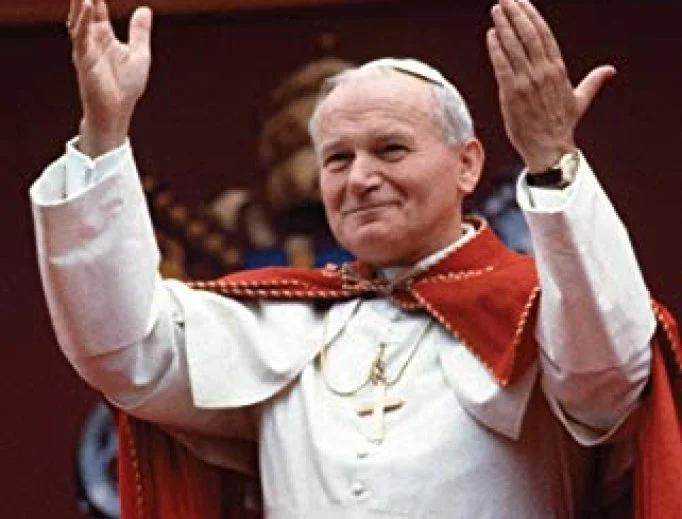
This contradiction cuts deeply. How can she long for the image of a loving family while actively preventing the very relationships that would make that image real? Drawing on the wisdom of Pope St. John Paul II — her own Confirmation saint — I have come to understand why it is no longer possible for me to love her as my sister in any authentic, lived sense.
The Personalistic Norm: Persons Are for Love, Not Use
In his book Love and Responsibility, Karol Wojtyła (the future Pope St. John Paul II) articulated the personalistic norm:
“The person is the kind of good which does not admit of use and cannot be treated as an object of use and as the means to an end. In its positive form the personalist norm says that the person is a good towards which the only proper and adequate attitude is love.”
A person must never be reduced to a means to someone else’s end. Love affirms the other for their own sake. “Use” treats them as an instrument for one’s own pleasure, comfort, or image.
My sister wants the appearance of a loving family on her wedding day—the perfect photos, the warm glow of relatives gathered around her. But she refuses the actual persons who would make that appearance of a loving family actually real. She wants the effect without the relationship. In JPII’s terms, this is a form of use: family members become props for her ideal day rather than ends in themselves, worthy of being known, loved, and allowed to love in return.
When someone treats you this way, you cannot enter into authentic love with them. Love requires that both parties affirm each other as persons, not as accessories to a fantasy. If it doesn’t matter to you that someone isn’t in your life today, next week, or next month — it doesn’t matter if they are at a wedding either.
Love as Communion of Persons — The Heart of John Paul II’s Vision
St. John Paul II’s Theology of the Body and Familiaris Consortio present an even deeper truth: the human person is made in the image of God, who is a communion of Persons (the Trinity). We image God most fully not in solitude, but in loving communion with others.
“Man becomes the image of God not so much in the moment of solitude as in the moment of communion.” (Theology of the Body)
In Familiaris Consortio, he writes that the family “is a community of persons” founded and given life by love. Without love that is mutual, self-giving, and open, “the family cannot love, grow and perfect itself as a community of persons.”
This communion requires knowledge and openness. In the biblical sense, to “know” someone is to enter into intimate relationship. In the state of original innocence, the man and woman were “naked and not ashamed” — completely transparent, with nothing hidden, fully known and fully accepted.
My sister has chosen the opposite: she has closed every door. She does not want to be known in any way by me. She does not want to know me. She has explicitly asked to be left alone. I’ve left her alone now for many months despite it daily destroying my heart and the love we used to have and knowledge of each other we used to share each day.
Without even the most basic openness to relationship, while actively asking to be left alone and refusing to ever let the guard down or contact, the communion that JPII says defines authentic love and family life becomes impossible. I cannot love her— the concrete, living person she is today — because she has made it impossible for me to know who she is now. I can only love a memory or an idea of her. That is not love of a person; it is something else. Ironically, she describes the situation as impossible even as she refuses the one thing that would make a relationship possible: simple openness to being known together. The only real barrier and impossibility of communion has been her own unwillingness.
Forgiveness Is Possible — Reconciliation Is Not
St. John Paul II was a profound witness to forgiveness. He forgave the man who tried to assassinate him. He taught that “forgiving from the heart can sometimes be heroic.” He insisted that we must be ready to forgive and that asking and granting forgiveness is “profoundly worthy of every one of us.”
I can (and must) forgive my sister. Forgiveness is an act of the will by which I release resentment, refuse to wish her harm, and continue to will her true good. It does not depend on her response. This is the love of Christ — agape — that we are all called to extend even to those who hurt us.
However, JPII also taught clearly that reconciliation is different from forgiveness. In Reconciliatio et Paenitentia and Familiaris Consortio, he shows that reconciliation restores communion. It requires movement from both sides: conversion, openness, mutual pardon, and a willingness to rebuild relationship.
“Family communion can only be preserved and perfected through a great spirit of sacrifice. It requires… a ready and generous openness of each and all to understanding, to forbearance, to pardon, to reconciliation.”
My sister has closed that door. As of this moment in her still not reaching out for these years, she does not want reconciliation. She does not want relationship. Therefore, while I can forgive her, I cannot have the reconciled, communal love of siblings that once existed (even however imperfectly) over fourteen years. That specific form of love — the love proper to a sister who knows and is known — is no longer possible.
The Tragic Irony of the “Picture-Perfect” Wedding
She wants to be surrounded by a loving family on her wedding day. Yet by her own choices she has made an authentic loving family impossible. The photos may look beautiful. The day may feel perfect on the surface. But the substance — the real communion of persons JPII says is the very meaning of family — will be missing if it continues to be at that time, what it is still today, for her choices. If she were to be married today, and we were there, she would not be surrounded by a loving family — because she has not allowed us to know, and therefore love, her anymore.
This is the deepest sadness: she is choosing an image of family love over a reality of family love, and in doing so she is depriving herself (and those who once loved her) of the very thing she claims to want - us “there” with her - in other words, communion - love.
Moving Forward in Truth and Peace
It is not possible to love my sister as a sister anymore right now with her guard and wall still up — not in the way love actually works according to the teachings of St. John Paul II. Love is not a feeling we can manufacture on demand just because it is a wedding day. It is a commitment to the good of a person that expresses itself in self-gift and seeks communion. When the other person completely refuses to be known or to allow any relationship, that communion is severed, and love is blocked and made impossible.
What remains for me is this:
To forgive her fully and from the heart.
To continue willing her true good and praying for her every day.
To respect the boundary she has drawn in demanding no contact from me directly to her.
To grieve honestly the loss of the sister-relationship we once had.
To refuse to participate in the illusion that a “loving family” exists when the persons involved have made it impossible.
To readily accept the day she finally chooses to be open and reach out again wanting to love and be loved.
St. John Paul II reminds us that the truth sets us free. The truth here is painful but liberating: I cannot love someone who will not let herself be loved in any real way. I can only love the memory, or love her from a distance as a fellow child of God.
May God grant her the grace to one day open her heart again — not for my sake, but for her own. She’s been running for a long time from what He has made her for seeking a picture perfect image of something the world keeps pushing in her feeds instead of the real Love He made her for. Hopefully one day she’ll see that Love of His before it is too late. And may He give all of us who have been shut out from being allowed to love her the grace to forgive, to let go, and to find peace in the only Love that never closes its door: the Love of Christ Himself.
If you are walking a similar road of family estrangement, know that you are not alone and you are not failing at love. Sometimes the most loving thing we can do is to stop pretending a relationship exists when one party has made it impossible. Forgiveness remains possible. Communion does not — not without the other person choosing to open the door. Accepting that communion is not possible because someone else does not want it and is choosing instead for this reality to continue each day is difficult, but honest. But here is the good news: just like my sister, your loved one also can change that decision any day they choose. Today, tomorrow, or next year — the same openness that she extended without a guard up to let a stranger begin to be known and know her, leading to such a profound “yes” in only a year, could one day extend from her to family again if she chooses to. In fact, even more easily because of the shared history of being known and loved before. Then the picture-perfect image she desires could finally become a snapshot of something far greater: real, lived love — the very thing wanted by everyone so much more deeply than the picture, and not just for one special day, but for every day.
St. John Paul II, pray for us.